Showing posts with label Random Thoughts. Show all posts

Thursday, May 19, 2011

Singing in the Darkness


One of the things we miss most about our life in Tokyo is songbirds. Oh, there are some birds of a crow variety that remind us of Alfred Hitchcock’s story Birds. But their voices are raspy and threatening, and these vulture-like creatures will attack anything—including people—if they’re provoked.

The hillside behind our house in Kobe was a different scene entirely. There a choir of the most exquisite and talented singers I’ve ever heard serenaded us regularly, filling our spirits with peace and gladness. As I said, we do miss the songbirds in Tokyo.

Needless to say, we’ve been pleasantly surprised at the birds here in Anderson. Bernie has purchased a bird feeder and seeds to coax them closer to our dining room window, and they’ve come—first a cardinal couple, a variety of titmouses and sparrows, and others we’ve not yet identified. We’re waiting for hummingbirds to discover the nectar and feeder Bernie added to our window bird sanctuary, but so far, none have come our way. Nevertheless, the song of the birds is a true gift from God to us.

Maybe it’s a cultural difference, but for some reason, the crows in Tokyo don’t sing until the new day begins dawning. Here in Anderson, I realized one morning that the birds were singing even in the early morning darkness. I’d awakened early and was surprised to hear the choir warming up already. It wasn’t long before God used the birds’ chorus to encourage and challenge me.

The news from the doctor wasn’t very good. Blood and test results showed new cancer activity, disappointing news to have to digest yet again. I felt a huge sigh escape from my lips as I began to think about the implications of what he was saying. Naturally, I wished the news were different.

But I was different in the morning. Starting a new day in the darkness once again (I do not like daylight savings time), I heard the songbirds. Suddenly I was reminded, “The birds are singing in the darkness.” As new images flooded my mind, I thought about how darkness represents the negative while light represents hope and life. Sometimes our circumstances are difficult and dark, but they shouldn’t be allowed to dictate negative responses. We can choose how we respond and whether or not we’ll sing in the darkness. My recommendation? Sing in the darkness.

Paul and Silas did (Acts 16). The prison doors flew open, their chains fell loose, and they were free—all because they chose to sing in the darkness.

The birds have made that choice. I have, too.

Saturday, May 7, 2011

Coming Full Circle

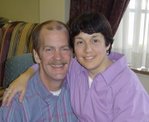
My parents, Bernie and me


“…for I know that through your prayers and the help given by the Spirit of Jesus Christ, what has happened to me will turn out for my deliverance” (Philippians 1:19).

The foremost missionary ever, Paul was talking about his being a prisoner for Christ. That is “what has happened to me.” In my case, what has happened to me is cancer.

Paul goes on in verses 20-21: “I eagerly expect and hope that I will in no way be ashamed, but will have sufficient courage so that now as always Christ will be exalted in my body, whether by life or by death. For to me, to live is Christ and to die is gain.”


Hallelujah! No matter what happens to me physically (though I always pray for healing), I do desire that my life and my death will indeed glorify you, Heavenly Father. A life of meaning, a life of faithfulness, a life of influence and witness for the sake of the Kingdom. This is how I’ve always wanted to live, Lord God. Thank you for giving me the courage need to do so. Thank you also that when I’ve failed, you’ve always accepted, loved me anyway, and forgiven and purified me according to 1 John 1:9.

But what of the deliverance mentioned in verse 19 above? Surely getting cancer isn’t deliverance—except deliverance into the hands of pain and suffering. Surely this isn’t a truism. Yet it is! As I was challenged to think about the other day in my conversation with my mentor and friend, Ann, the closing of doors is opportunity for new doors to open that wouldn’t be possible otherwise. What doors have been opened for me as I’ve been delivered from a very busy—much too busy—schedule because of cancer?

Doors of discovery. How many lessons you’ve taught me, Father, in these two years since my kidney was removed in April 2009. Among the most important are lessons related to patience and finding my value in being with you rather than in doing for you. Doing, I’ve discovered, was where I was finding my value and identity, despite the fact that Scripture clearly teaches that these are found in you alone.

As for the discovery of patience, though it is tested regularly through cancer, I’ve discovered I really am becoming much more patient person—something I’ve prayed about forever (it seems). I’ve been eager for the Fruit of the Holy Spirit (among these, patience) to grow in my life. Maybe, in your infinite wisdom, Lord, you knew that the only way this would develop into the desired plump and delicious fruit would be through cancer and all the related trials, especially when we’ve had to wait so long for many of our prayers to be answered. But praise God! You are answering these prayers, one after another, in your perfect timing.

And what of Paul’s assertion that, “For me to live is Christ and to die is gain,” in verse 22 above? Actually, reading this was a little hard for me this morning, especially as Paul continues n verses 22-23: “If I am to go on living in the body, this will mean fruitful labor for me. Yet what shall I choose? I do not know! I am torn between the two: I desire to depart and be with Christ, which is better by far . . . .”

I do desire Christ; I do desire to have fruitful labor for God. I do agree wholeheartedly with these words. But to desire to depart this body in order to be with Christ? Honestly, I shout out a resounding NO!. “Yet not my will, but yours be done,” Jesus prayed in the Garden of Gethsemane. I, too, will yield to your perfect will, Lord God—and it is perfect according to Jeremiah 29:11. But, in the meantime—before that perfect will opens new doors of opportunity—I desire to stay right here in this body, weak as it is (though I praise you for the strength you give me daily, Lord). I want to be here for others, as Paul expressed so eloquently. I want to be here in this body in order to see others come to Christ and grow in him to be like Jesus.

But I also want to be here for my family. Today is my mother’s 87th birthday. What a tremendous influence for good she’s had over the years. I’ve not always been a gracious and grateful recipient of her many lessons. (Often I’ts been years later that I’ve come to understand the value of all she’s taught me by word and example.) But I also want to be here for Bernie, Benjamin, Stephanie, Donald, Little Ben, Hosanna, and my yet unborn third grandchild who whom I will meet later this year. I want to see the three little ones grow up to be people of God. Just as others have influenced me over the years, I pray for many more opportunities to influence my grandchildren, to laugh with them and to enjoy and share in their lives. I pray for the building of many more memories. No, I am not yet ready to depart.

Still, this I know with confidence: “There is a time for everything and a season for every activity under heaven: a time to be born and a time to die . . .” (Ecclesiastes 3:1-2).

I praise you because you are the creator of all time, Lord. I worship you this morning with full confidence in YOU—with joy in the knowledge that whatever happens and when, you are in control and that time is in your hands according to your perfect will that desires and carries out what is best for me.

One more lesson of discovery: I don’t have to understand things in order for whatever happens to be the best for me. God is perfectly able to understand. In fact, he does understand because he is the Creator God, all powerful, all knowing—and it is his choice whether or not he explains to me in part or not at all. This is a part of my trusting him and fixing my eyes on what is unseen (God and his perfect plans) rather than only on what is seen (the world I understand around me). How freeing that I don’t have to figure it all out! Thank you, Lord, that I can just relax in you and leave it to and with you. What a peaceful way to live! And to think that “what has happened to me [my cancer] will turn out for my deliverance [has turned out for my deliverance]”, as Paul wrote in the very first verse I read from Philippians this morning.

And here I am having come full circle in my musings this morning. Thank you, Lord, for the journey on which you’ve led me through the Bible and the thoughts you’ve given me as I’ve read. It’s been a fascinating and eye-opening journey, and I’m so grateful—yes, even grateful for my cancer. What gifts you’ve given my, Lord! “Every good and perfect gift comes down from above . . . .” How I praise and thank you.

Thursday, March 24, 2011

Sleeping Like a Baby


One of the questions we’re asked frequently by Americans is, “Are you fluent in Japanese?” After living 30-plus years in Japan, I would hope so.

But the truth of the matter is that fluency fluctuates wildly depending upon the subject matter. Those subjects that I know well make me appear to be fluent; others leave me so completely in the dark and so unable to speak, participate, or understand a conversation that I must appear to others to be blind and deaf—certainly not fluent. But I get along well enough. In my own brand of fluency.

Consequently, in coming back to America for this time of medical treatment, I’ll admit I was looking forward to watching television in English. Ah! Kick back and enjoy while understanding without straining. And there were several crime dramas that fascinated me. Although I’ve never watched much TV, I was intending to acclimate back to life in the United States in part through television. Now I know the truth: “enjoy” and “television” are opposite words and should never appear in the same sentence.

One evening I nestled into the recliner and turned on the TV, eager to watch a drama that had been advertised. Although I’d seen only infrequently, I remembered that it wasn’t overly graphic in depicting crime scenes; much was left to the imagination. While enjoying the drama of solving an intriguing crime story, I don’t like blood, guts, and violence, so that was great for me. Only it wasn’t great. I spent the whole hour shivering with tension and dread. I wish I’d turned off the TV. Instead, I watched until the troubling end, following which I headed for bed.

Big mistake. That night I tossed and turned and wrestled, perhaps with the devil himself. It was the worst night I can ever remember. In the morning, I awoke feeling defeated, pessimistic, afraid, worried, and definitely not rested or refreshed mentally or physically, either. I was a prisoner in a dark, deep cloud from which I could not escape, no matter how I tried.

Although I fought it, the negativism continued throughout the day. Mid-afternoon, as I cried out to the Lord for relief from the battle of doubt and pessimism, God reminded me of Paul’s admonition in Philippians 4:8: “Whatever is true, whatever is noble, whatever is right, whatever is pure, whatever is lovely, whatever is admirable—if anything is excellent or praiseworthy—think about such things.”

Suddenly it all made sense. These instructions on good living weren’t given just to be restrictive and because God has no sense of adventure and is a stick in the mud. They (and all the mandates and advice in the Bible) were given to protect us for they are the keys to our freedom rather than to our imprisonment.

As I contemplated this quite obvious truth that somehow had never spoken to me quite this way before, I remembered an illustration author Randy Alcorn makes in his excellent little book, The Purity Principle. He describes a winding road that runs dangerously close to the edge of a steep precipice in the mountains. Because of the risk, there are many sturdy guard rails lining the road, especially at the curves. Alcorn depicts a scene where a car collides with the rail and then asks the reader this question: Do you suppose that when the driver gets out to inspect the damage, he curses the guard rail for scraping up the side of his vehicle? No! Instead, as he looks down the mountainside that is littered with other wreckage, he gives thanks to God for the guardrail that saved him from what would have been the same tragic fate.

I’ll not forget Alcorn’s illustration. God’s instructions are wise and intended for our good, and they relate to our whole lives—even the shows we watch on television.

By the way, I’ve been sleeping like a baby recently.

Friday, March 11, 2011

Praising Now and Forever

Praising God in the promise of springtime after a long, hard winter

“Let this be written for a future generation, that a people not yet created may praise the Lord” (Psalm 102:18).

What an amazing thought—God has planned for us to praise him long before we were created or even thought of! That’s how important it is for us to praise God. This is what he desires. (Could it be said he desires this most?). God desires our praises and this is planned into his eternal design. Amazing. It is not so much what we do for God as how faithful we are to be instruments to praise him as he desires.

Praise. That is my assignment for today. Beyond anything on my “to do” list, I am to praise God “[who remains] the same, and [whose] years will never end” (Psalm 102:27). Praising now and forever. It is my mandate. May I ever be faithful is my prayer.

Saturday, February 26, 2011

Forgot the Carrots?

Look closely for the baby carrots, but mostly see the smiles
of mother, daughter, and grandmother

It was a joy to have a number of family members and some Japanese friends gather in January in Anderson. Somehow I reaped at least a little energy from our grandchildren, Little Ben and Hosanna, that has nourished me since. It was wonderful—except when Hosanna discovered her, “Give me!” voice. High-pitched, insistent, and in only one volume(LOUD), Hosanna’s voice sent me to our bedroom every afternoon for some respite. Also I had to get my ear plugs. It was the only way I could survive.

However one day, I forgot to remove the ear plugs before exiting the bedroom and joining everyone in the main room. Benjamin was the first to notice.

“Coco, why do you have carrots in your ears?” he asked before laughing uproariously at his joke. (He was comparing my ear plugs to the baby carrots with which we kept the refrigerator stocked as a snack food.)

After that, whenever he saw the plugs, he always laughed and asked, “Did you forget your carrots?”

Which is a question the Lord asked me the other day. Well, not exactly. But God did address me clearly—and surely with a smile on his face—“Did you forget me in the midst of everything going on? I’m as close to you as your ear plugs, and you don’t even seem to realize it.”

Yes, I believe that for too many days I’ve forgotten the carrots. They’re as close as “in my ears,” but still I’ve forgotten:

*All the people serving us as the Lord’s hand and feet through providing meals a couple of times a week;

*All those praying faithfully for us and believing in God’s miracles as together we walk this cancer journey;

*That God never changes, no matter what medical tests discover; and,

*That He is always worthy of my praise.

Open my eyes once again, Lord, that I may see you and experience you afresh in this day. Thank you for reminding me about the carrots.

Friday, January 28, 2011

The Stray Notebook


“Jesus is always with you, always Jesus is with you.”

The words were printed in a child’s script and encased within the skeletal body of a fish—a large, hand-drawn fish swimming across the page of notebook paper. Perhaps this was the whale that had swallowed Jonah in the Old Testament?

In any case, that was the scene I imagined when I read the words, “Always Jesus is with you.” And I added the thought: even if you happened to find yourself in the belly of a whale. What encouragement it must have been to a cold, wet, smelly, reprimanded Jonah who was intent on running away from God and his perfect plan for Jonah’s life. What an encouragement to me as well, waking up groggily after a night that was less than satisfactory: I was not alone. It was the message I most needed.

Who had left my cheery reminder to greet me that morning? To my surprise, as I looked through the orange notebook, I realized that what I’d found while looking for some scrap paper was more than 30 years old. Even more interesting, it had belonged to my sister-in-law. (It had been a university physics class notebook for her.) A little girl named Tabitha had found it in one of the apartments missionaries share when they are visiting their supporting churches across the United States, and it had become hers for doodling, drawing, and otherwise reminding herself of life’s important lessons. Tabitha didn’t quote the Bible word for word, but the message from the Lord was indeed the same: “Never will I leave you; never will I forsake you.’ So we say with confidence, ‘The Lord is my helper; I will not be afraid’” (Hebrews 12:5-6, NIV).

It is the message I need every day as I move through three-to-four weeks of daily radiation treatments (Monday to Friday) and continue traveling the cancer journey. I am being supported by the Lord as he works through a stray notebook, friends, family, and many people I don’t even know to bring me encouragement and the reminder that Jesus is always with me.

Obviously children can grasp and believe this vital message without difficulty. My prayer is that I, too, may have the innocent heart of a child to believe that God is walking with me and guiding me, and that he will never leave or abandon me, no matter where he leads. In Jesus’ name, Amen.

Monday, October 25, 2010

Arguing with God

Hanajima-san, our Japanese mother

“I have to tell you that I’ve been doing a lot of arguing with God,” kimono-clad Hanajima-san told me at the airport on Tuesday. Although mostly confined to a wheelchair, she was insistent that her son drive her husband and her to the airport so that she could see us off to the United States for our consultations at M. D. Anderson Cancer Center.

“What have you been arguing with God about?” I asked, chuckling at the image of this diminutive Japanese woman shaking her fist at God.

“About you,” she answered immediately. “I just don’t understand why my prayers for you aren’t being answered and why you have to suffer so much.”

Although I assured her that I’m not suffering, just extremely fatigued, and reminded her that whatever God allows, he allows from a heart of love for his children, this faithful Christian woman for more than 50 years wore skepticism on her face as if it were the white powdery makeup Japanese are most fond of wearing.

Perhaps this woman I call my Japanese mother will have more words with God after she gets this update:

1)Surgery is no longer an option because my cancer is now in a progressive state. A cancerous tumor (though small) is now evident on my remaining right kidney;
2)Three drug therapies that have shown the most promise with renal cell carcinoma (RCC) have failed for me in the past year, leaving fewer and fewer treatment options. Dr. Tannir, my main oncologist, now recommends an experimental combination of two cancer drugs (one oral and one administered by IV) that have shown some success (10%) in controlling and shrinking RCC. Two of his patients have even gone into remission with this combo chemo treatment. A two-month regimen will be enough time to determine whether this works for me; and,
3)Bernie and I have decided that I will remain in the U.S. for this two-month period and the follow-up checks at M. D. Anderson in early January. I will take treatment in Anderson and stay at my parents’ house while Bernie returns to Japan until Christmas.

Needless to say, we need your prayers now as much as ever. Pray especially that the new treatment will stop the cancer growth, shrink the tumors, and send the cancer into remission. Secondly, please pray that through all of this, God’s glory will be shown and we will continue to have opportunities to testify to his love, mercy, and power both in Japan and the United States. (We were encouraged that Dr. Tannir continued to affirm our calling as missionaries in Japan.)

By the way, as uncharacteristic as it seems for me—one who has never been reticent about arguing what I think is a valid point—I am not arguing with God. Disappointed with the news? Of course I am. But I cling to God’s words of promise written in Jeremiah 29:11: “For I know the plans I have for you,’ declares the Lord, ‘plans to prosper you and not to harm you, plans to give you hope and a future.’” They were true before this visit to M. D. Anderson and they are true today as well.

Friday, October 8, 2010

Good News

We're smiling, along with our granddaughter, Hosanna.

“He tends his flock like a shepherd: He gathers the lambs in his arms and carries them close to his heart” (Isaiah 40:11).

How we sense we are being carried close to the heart of God! Even before we’d sent out all the updates from Cheryl’s CT scan results on October 5, God was answering the prayers we’d requested be lifted up—so much so that we had to update the update and revise the prayer requests along the way.

Here is the good news about how God is already answering prayers:

1) M. D. Anderson moved up our appointments from November to October 20-21;
2) We were able to get airplane reservations for October 19;
3) Without Bernie’s asking, the executive committee of Tamagawa Seigakuin told Bernie that they would cover for him to be gone until November 5, excusing him not only from the day-to-day but also from rushing back for a scheduled trip to Korea during the last week of October;
4) Just this morning, Cheryl was able to get her ticket upgraded to business class with miles, making the long return flight much easier on her physically;
5) A pastor called last night and offered to drive us to the airport on October 19. This means we’ll not have to navigate two-three hours of stairs, trains, changes, and walking with our suitcases from our local station to Narita Airport; and,
6) We have been overwhelmed by the outpouring of e-mails and phone calls (some from people we don’t even know) that assure us of God’s wonderful care for us through his people, the church.

As you continue praying for Cheryl’s healing, please also pray for consultations with the surgeon on October 20 and the kidney oncologist on October 21. Pray especially for their wisdom and ours at this time. While we don’t know whether surgery is still an option or even the best way to respond to the current situation, we feel that we’ve come to the crux time in Cheryl’s treatment. And, if not surgery, how should we proceed from here? We desire most to experience God’s guiding hand in all decisions that will be made.

Of course, we also desire for Cheryl to be able to return to Japan as soon as possible. There is still so much to accomplish in this country that has been our home and mission field for 30+ years. Our prayer is that God is glorified in Japan through us and even through our cancer journey. Thank you for joining us in the battle through your fervent and believing prayers.

Tuesday, October 5, 2010

The Latest Update on Cheryl


The roller coaster ride continues. Mind you, I’ve never been a fan of roller coasters.

Bernie and I met with the doctor today to hear the results of a CT scan I had on October 1. Considering how I’ve been feeling for the past three weeks or so, I wasn’t surprised with this news:

1) The main tumor continues to grow, albeit slowly;
2) A lesion in the right kidney that has been unchanged for years has grown somewhat;
3) Something has appeared in my liver but the radiologist cannot say what, although metastasis is a possibility; and,
4) My doctor says my cancer is now in a “progressive” situation (which he called serious) and he is urging me to go the States as soon as possible.

As you continue to pray for my healing, here are a few other specific prayer requests:

1) That M.D. Anderson Cancer Clinic will be willing to move up my scheduled appointments from November 8-10 to sometime in the next two weeks;
2) That we will be able to make all the necessary arrangements to enable us to go quickly;
3) That our going will not cause great trouble for those who will have to cover for us at Tamagawa Seigakuin, Tamagawa Church, and in other areas of our responsibilities here in Japan; and,
4) That the doctors will have wisdom in knowing what course of treatment should be followed at this point.

Despite CT scan results that were less than favorable, we affirm what I wrote one month ago as I looked back on one year since my cancer had recurred:

God is worthy of praise. Always. Forever. No matter what CT scans and blood tests show and doctors proclaim. No matter how I feel. No matter what. None of these change or challenge the always faithful, always powerful, always in control God. So I join the Old Testament prophet Habakkuk to proclaim, “Though the fig tree does not bud and there are no grapes on the vines, though the olive crop fails and the fields produce no food, though there are no sheep in the pen and no cattle in the stalls, yet I will rejoice in the Lord, I will be joyful in God my Savior” (3:17-18).

Please join us in praying AND in praising our faithful God.

Thursday, September 30, 2010

End of September Thoughts

Bernie and Mike sing at Tamagawa Seigakuin's 2010 school festival.


September used to be one of my favorite months. Notice the past tense.

When I was a child, September meant the start of school. Not that I was eager for the summer holidays to end, but I did look forward to some new clothes, a new lunch box, and meeting my friends again for the new school year. September always spelled new and exciting to me, even if year after year our first assignment back was to write, “What I Did during My Summer Vacation.” (Although I didn’t voice it out loud, I did often wonder why teachers couldn’t be more creative in assigning paragraph topics.)

But that was a long time ago. These days I’m starting to think that it might be good just to jump from August right into October—at least if the last two Septembers are indicative of what the month is going to hold for me in the future.

It was early September 2009 that I learned my cancer had recurred. Then while waiting for test results to determine which course of treatment would be recommended, I found myself shadowboxing with fear, an opponent that was definitely present even if I couldn’t see it. In our sparring, I also discovered many opportunities to doubt God and his good plans for my life. I’m grateful that I emerged from that September stronger than ever in my faith, but I did have some scars to show from the battles.

I remember one day in particular. Despite feeling weak physically, I attended the annual school festival at Tamagawa Seigakuin. I’d be there only an hour or two at most, or so I thought. I knew I had a fever that was getting higher, but I couldn’t go home immediately. Complicating matters further, I met an acquaintance who offered to introduce me to a faith healer. Let me say it clearly: the Bible teaches that God is a healing God; it instructs us to ask him for healing; and I believe God can and does heal, even miraculously, even cancer. So there shouldn’t have been any problems.

But when I showed interest in her suggestion, my Christian friend lowered her voice conspiratorially and told me that this faith healer was Buddhist, adding, “But that’s okay. We all believe in the same God.” Do you realize what you’re saying? I wanted to shout out loud in my shock. Instead, I recoiled from her involuntarily as if she had the plague. Although I did accept the faith healer’s calling card from her, I asked Bernie to burn it later that evening. I felt strongly that I had to get rid of the evil I’d carried into my home. We also prayed together, asking God to put his shield of protection around us. As we did, peace returned to my troubled heart even as my high fever finally broke. Even now, more than a year later, I’m convinced my faith was on trial that day.

And this year? The trial continues, but in more subtle ways. After six relatively “healthy” weeks in which it was sometimes easy to forget that I have cancer, my oasis in the cancer journey has come to an end, at least for the time being. Fatigue has returned and, more recently, pain has become its companion. On top of this, I’m coughing again and running a low grade fever most days. All of this is right on the heels of my writing a victorious blog on September 4 in which I testified about the wonderful lessons God had taught me in the year since my cancer recurred. Those lessons haven’t changed, but it is definitely harder to share them jubilantly when I’m not feeling good and when doubts have begun assailing me once again. The trial is not over.

Needless to say, I’ll be glad to put yet another difficult September behind me and to enter October tomorrow. Of course, I have no way of knowing what October will hold. Yet these words of Paul renew my confidence and restore my hope:

“Therefore we do not lose heart. Though outwardly we are wasting away, yet inwardly we are being renewed day by day. For our light and momentary troubles are achieving for us an eternal glory that far outweighs them all. So we fix our eyes not on what is seen, but on what is unseen. For what is seen is temporary, but what is unseen is eternal” (2 Corinthians 4:16-18).


Saturday, September 4, 2010

One Year Later

Bernie and Cheryl, September 4, 2010

September 4, 2009. One year ago today. It was the day a doctor told me he suspected my cancer had returned. He was right.

In looking back over this incredible year, I’m grateful for so much, not the least of which is the fact that I’m much healthier today than then—and that, even though I still battle cancer. I’m also grateful for the lessons God has taught me as we have journeyed these past twelve months. Some, if not most, are lessons yet in progress. (I seem to be a slow learner who requires application after application for a lesson to really be absorbed.) Without any specific order, here are ten I’ve been learning in this past year:

1) Patience. I’d far rather just jump right to healing, but it’s been a year of wait, wait, and wait some more. I’m still waiting. After the cancer recurred, I had to wait a very long three-plus weeks before I could start taking the first anti-cancer medicine. Every two weeks thereafter I waited for the results of tests to show if the drug was being effective. When in March 2010 a CT scan showed that Sutent had stopped working, I had to wait another endless three weeks before the second drug, Afinitor, became available in Japan. What really tested my patience (and faith) was that throughout this wait my body was weakening noticeably. Most recently, I’ve been waiting since May to see whether doctors will set a surgery date as a way that I might become “cancer free.”

“Wait for the Lord; be strong and take heart and wait for the Lord” (Psalm 27:14). Waiting requires patience, which doesn’t come easily to me. Perhaps this is why I’m being given so many opportunities to learn this lesson.

2) God is worthy of praise. Always. Forever. No matter what CT scans and blood tests show and doctors proclaim. No matter how I feel. No matter what. None of these change or challenge the always faithful, always powerful, always in control God. I join the Old Testament prophet Habakkuk to proclaim, “Though the fig tree does not bud and there are no grapes on the vines, though the olive crop fails and the fields produce no food, though there are no sheep in the pen and no cattle in the stalls, yet I will rejoice in the Lord, I will be joyful in God my Savior” (3:17-18).

3) My trust is in God. It is not in percentages: the efficacy rate of a certain drug, the chances that surgery will get all of the cancer, survival rates for renal cell carcinoma, and more. My trust is in God, my Father, whose word never fails because he is “the same yesterday, today, and forever” (Hebrews 13:8).

“God is our refuge and strength, an ever-present help in trouble. Therefore we will not fear . . . . Be still, and know that I am God; I will be exalted among the nations, I will be exalted in the earth” (Psalm 46:1, 2, 10).

4) And a related lesson: doctors don’t know everything. Even their guesses—educated though they may be—are only guesses. Will this particular medicine work? What treatment is best? Should they perform surgery? How about radiation? How long will I live? Only God knows. I am so happy that my trust is in him.

5) My husband stands beside me “for better, for worse, in sickness, in health.” Never have my wedding vows been so meaningful; never has Bernie’s love been so real. I don’t have cancer—we have cancer. We travel the journey and fight the battle together.

6) The family of God is truly amazing. “Even youths grow tired and weary, and young men stumble and fall; but those who hope in the Lord will renew their strength. They will soar on wings like eagles; they will run and not grow weary, they will walk and not faint” (Isaiah 40:30-31). How often during this year Bernie has commented that it is the prayers of the family of God around the world that provide the updraft for the eagle to soar. A prayer partner in Missouri said it a different way when she wrote, “When you can’t pray, remember that we’re praying for you.”

7) The cancer journey shouldn’t be walked alone. It’s a journey for the whole family—both one’s blood family and the wider family of God too. Why would anyone choose to go inward, silently bearing the burden while trying to keep a stiff upper lip and a smile on the face? Why would anyone choose to walk alone? It happens often in Japan where people are so private about personal matters. Solo journeys may be adventuresome and break Guinness world records, but the cancer walk should not be attempted alone.

8) God’s Word is powerful and full of promise and hope. It is the way God has spoken to me most often this year. I have been renewed, strengthened, comforted, challenged, nourished, and sometimes chastised. Jesus quoted the Old Testament in Matthew 4:4 when he answered Satan’s temptations: “Man does not live on bread alone, but on every word that comes from the mouth of God.” Neither do I live by anti-cancer medicines. Far more important is the Word of God—something I’ve “known” my whole life, but never as I have known it this past year.

9) What you don’t know won’t kill you. Cancer kills, of course; a lack of knowledge doesn’t. Therefore, even as I pray for healing, I pray for my doctors (who’ve studied and are knowledgeable, but only to a degree). I’ve chosen not to focus on the cancer itself. Instead, I want to focus on the Lord and on walking with him. “Whatever is true, whatever is noble, whatever is right, whatever is pure, whatever is lovely, whatever is admirable—if anything is excellent or praiseworthy—think about such things,” Paul wrote in Philippians 4:8. It is good advice for me—the very best.

10) My worth doesn’t stem from what I do. It is based on who I am: God’s beloved child. So many scriptures testify to this fact, yet I confess I’ve often acted like the more productive I am, the worthier I am. If you look at my date book, I’ve not accomplished much during this year. Instead, I’ve been with the Lord in his school of learning and I’ve come out in a much better place and with much greater understanding of God. It’s a far more stable place to be for I stand on a foundation that cannot be moved. It’s a new kind of productivity that I’ve discovered: delighting myself at Jesus’ feet even if I accomplish nothing else during the day. It is enough.

“Delight yourself in the Lord and he will give you the desires of your heart. Commit your way to the Lord; trust in him and he will do this: He will make your righteousness shine like the dawn, the justice of your cause like the noonday sun. Be still before the Lord and wait patiently for him” (Psalm 37:4-7).
Wednesday, August 18, 2010

Not a Chance Encounter


Emma. I met her poolside, overlooking the beautiful ocean of Mexico’s Cozumel resort island where we were vacationing. We were unlikely conversation partners: she, in her mid-twenties, on her honeymoon, and holding a can of beer in her right hand while occasionally drawing in from the cigarette in her left; me, enjoying the solitude and quiet of the sinking sun whose pink, red, and orange hues were gradually transforming the western sky into an exquisite palette of breathtaking beauty.

Actually, I wasn’t in the mood for talking with anyone, especially one so obviously “different” from myself. Only a short time earlier, I’d given into the tears that had threatened all day. It was the last day of our vacation, but more than that, it was only one week before we were to return to Japan. (It’s always hard to say good-bye, no matter how many times we do it since returning to Tokyo means facing a lifestyle and locality I’ve never yet in seven years grown to appreciate. The transition never comes easily.)

I’d been ignoring the reality of the passing days and what was coming, but with only a week remaining, I couldn’t pretend time didn’t matter any longer. So the tears had come, first only a couple escaping down my cheeks, and then suddenly a torrent was shaking my shoulders. Bernie sat with me on the couch, delaying his snorkeling to stay with me until the flood subsided. Shortly, I made my way outside to be comforted by the approaching sunset.

Alone and drinking in the peacefulness of the landscape, I was reminding myself to hold it close to my heart so that I will be able to conjure up the comforting memory when I feel irritated by 27 million people soon crowding me unmercifully in Tokyo. And here came Emma.

“Buenas noches,” she greeted me cheerfully. I smiled and responded, “Hi,” in English, signaling that I wasn’t Mexican and couldn’t converse with her in Spanish. Apparently she couldn’t have gone much further herself because she breathed a sigh of relief and immediately switched into English. Sitting down on the edge of the elevated pool area, she struck up a conversation. One topic led to another and before long I was answering an oft-repeated question when someone discovers we’ve lived in Japan for 30-plus years.

“Wow! That’s a long time,” Emma marveled at our tenure, telling me that she was only 26 years old herself. “You must have been really young when you went. Wasn’t that scary?”

“When you’re young, you never imagine there’s something you can’t do,” I replied with a laugh, even as a voice inside told me not to miss this opportunity to share the real reason we went to Japan. It wasn’t just that we were young—I was 21 and Bernie 22—and looking for adventure; the main reason was God’s call upon our lives.

“Actually, we’re Christian missionaries,” I told Emma. “That’s why we went to Japan and that’s why we’ve stayed so long.”

As I expected, there was a momentary pause in the conversation as if Emma was wondering what she’d gotten herself into and evaluating whether she wanted to go any further. To my surprise, she proceeded to tell me that she is an agnostic who wonders whether atheists just might be right about the non-existence of God. Nevertheless, she is very curious about religion and has her own repertoire of religious experiences, including infant baptism in the Lutheran church and rebaptism in a Pentecostal church as a teenager.

What in the world can I say that will make any difference to Emma? I prayed silently as we conversed. In the end, I shared with my new friend that knowing God is not about religion, but about relationship. I urged her to continue keeping her ears open because God so desires an intimate relationship that he is pursing her, even through our talk. I also thanked her for our conversation after she thanked me for not judging her.

“It was a gift to me,” I assured her. Noting the quizzical expression on her face, I added, “It’s been a tough day, but the God I believe in and trust just used you to encourage me.”

Whether or not Emma can understand, I have no doubt that this was not a chance encounter. Through a confused agnostic, God reminded me of his desire to use me as his hands, feet, listening ears, and heart—even in Mexico. And most especially in Japan.

Sunday, July 4, 2010

Lessons through My Grandson

Waiting for the apples to turn red
Being a top student was always important to me in my school years. If I wasn’t going to win awards for my athletic prowess, my musical abilities, or my inventive genius, at least I could stand tall when grades were handed out. And I did.

Which is why it’s such a surprise to me that I’m so slow in learning some of life’s most important lessons—not the ABCs, but far more valuable things like trust, patience, and perseverance. The Lord, using my two-and-a-half-year-old grandson, is determined that I have every opportunity to catch up where I’m behind in my lessons.

“Coco, how’re you feeling?” Little Ben asked me as he walked into my bedroom where I was sitting, exhausted, in a chair.

“Not so good,” I responded, adding, “That’s why Coco’s a little sad today—because I don’t feel good.”

Without missing a beat and with all the certainty of an experienced and learned elder, Benjamin continued, “Jesus will help you.”

Smiling at my grandson for reminding me of such a fundamental truth—no matter the pain, how could I have lost my focus?—I hugged him and said, “You’re absolutely right! Jesus will help Coco feel better so I don’t have to be sad.”

“That’s awesome!” Benjamin returned. I wanted to hug him again, but he giggled as he escaped my reach and ran out of the room. End of the lesson, but I was left with a warm glow that, I suddenly realized, had uplifted both my sad spirit and my tired body. I knew I’d been visited by the Lord himself to restore my trust in him and his unconditional love and perfect plan for my life.

A few days later, it was time for yet another lesson. Benjamin and I discovered an apple tree at the back of the apartment complex where our families are spending the summer—and it was loaded with fruit. Benjamin wanted to begin eating immediately, but I explained that since the apples were still mostly green, it was too soon to pick them.

“Well, let’s wait,” he replied matter-of-factly. “We can wait till the apples turn red.”

“But that happens a little bit by a little bit,” I protested. To which Benjamin responded without the slightest bit of frustration as he sat down on the concrete parking block in front of the tree, “Little bit by little bit. We can wait.”

How long will you wait? I wondered to myself as I sat down beside him, facing the apple tree and its not-going-to-be-red-for-a-long-time fruit. What patience! More than that, what trust! With little concept of time, Benjamin was willing to sit and wait expectantly simply because he believed me when I told him the apples will turn red little bit by little bit. No doubts in his mind that what I said was true—just because I said so.

“Now faith is being sure of what we hope for and certain of what we do not see,” we’re told in Hebrews 11:1. I think of God’s promises of healing and answers to prayer—for all of us, for me. I realize again that I need to sit quietly more often—even on a concrete parking block—and wait patiently for the Lord to fulfill his words. If a two-year-old can do it, why can’t I?

Tuesday, May 18, 2010

A Ridiculous Raincoat


It was a rainy spring day. Everyone I met on my way to the train station was outfitted with umbrellas, rain boots, and raincoats, or some combination thereof. (I didn’t even own an umbrella and rain paraphernalia until we moved to Japan. Walking in the rain is not something anyone would choose to do in the United States. Rather, Americans simply jump in a car and avoid the weather--in the process, getting fat for lack of exercise, I might add).

In any case, my story is about a particular woman I passed who was walking her dog. Nothing unusual about that. After all, dogs must be walked even on rainy days. But wearing an aqua and blue checked raincoat? The dog, I mean, not the woman. Her coat was apricot-colored.

But at least she was walking the dog in the old-fashioned and, in my opinion, correct way. Only weeks ago my heart was warmed by seeing a family of three out for a walk. With his right hand pushing the stroller, the father was holding his little son’s hand in his left. The mother was holding the toddler’s other hand in her right, while also pushing the stroller with her left. I smiled, remembering such walks when our own son was that age. It was a cozy sight.

Until I noticed that the stroller wasn’t empty as it should have been with the not-yet-two-year-old boy walking. Riding inside it was the family’s dog. My smile faded quickly, replaced I’m sure by an incredulous look. The image I’d been enjoying was completely spoiled.

So, as I said, at least the woman in my neighborhood was actually walking her dog that morning, even if it was wearing a ridiculous raincoat. The dog wasn’t riding in a baby stroller or being paraded in its own specially-made-for-doggie pram. They do make them in Japan. In fact, for a mere $250 or so, you can get one near our house at a store called Harness Dog. In the same place, you can also purchase an outfit for poochie fit for the ball. You can also buy your own matching clothes. (And our kids used to roll their eyes when Bernie and I wore matching tee shirts!)

Although I have seen a dog wearing diapers in Jiyugaoka, I didn't see any on display when I walked into Harness Dog—not to admire the merchandise but to get the disturbing facts about how dogs often are treated in Japan. Better than children, I sometimes think. After all, how is it possible to spend such amazing sums of money on dogs, cute as they may be, when children under five years old are starving at the rate of 12 per minute?

“They’re not my children,” some might argue. “If people don’t have the money to raise them properly, they shouldn’t have so many children.” It may be a valid argument, but it doesn’t change the fact that in many countries, children routinely go to bed hungry or gaze listlessly with unseeing, sunken eyes at the world around them—until they die for want of only a small fraction of the food the developed world consumes and/or throws away daily. I simply cannot look the other way.

“From everyone who has been given much, much will be demanded; and from the one who has been entrusted with much, much more will be asked,” Jesus told his followers in Luke 12:48. To ignore is to disobey.

Of course, it’s not enough to scowl at dressed-to-kill dogs carried in their “mothers’” arms on a shopping outing or a visit to a dog cafĂ© to share tea. (This is not an exaggeration.) This is why for more than 30 years we’ve sponsored children through Children of Promise. (Currently we support two girls in India and another in Myanmar.) This Church of God child sponsorship program provides for the daily physical, spiritual, and educational needs of more than 3,800 children in 23 countries of the world. And there are many other excellent sponsorship programs that are also helping to alleviate the plight of destitute children in our world. If everyone would get involved and just do something—and I don’t mean dressing the dog in a ridiculous raincoat and going for a walk.

Saturday, May 8, 2010

When Missions is Spelled ABCs

A colleague as she teaches English to plant seeds for faith in children's hearts

“A missionary is someone who goes to another country to tell people about Jesus.”

This, or some variation of it, is what we usually hear from children in America when we visit their churches and ask if they know what a missionary is. Typically, the places they imagine missionaries go have lions, elephants, zebras, and other wild animals roaming freely, bringing an element of danger into the definition. Just as commonly, children (and many adults as well) also imagine desperately poor people begging for food, their sunken eyes and bony, stick-like frames a testimony to the dire straits in which they barely survive. Missionaries go to their lands and give them food—both the Bread of Life to satisfy spiritually and bread with calories to provide for them physically. This is the work of a “real” missionary.

We’ve been missionaries for more than 30 years and we’ve yet to see a gazelle, rhino, or such animal except in the zoo (although once there was a monkey that came down from Kobe’s Rokko Mountains and into our neighborhood, pausing shortly on our verandah to preen). It’s an entirely different world here in Japan, a nation that refashioned itself from the ashes of World War II into a modern economic miracle. We don’t fight wild animals and muddy, pot-holed roads to go to work—only unbelievably crowded trains and gridlocked highways. Every modern convenience is available at the snap of the fingers. Even the homeless of Tokyo are not gaunt for lack of food.

With Japan as it is today, perhaps some might wonder if there really is work for a missionary here. With less than 1% of Japanese Christian after more than 150 years of Protestant missions, the answer is an obvious yes. But just as obvious is the fact that methodology must fit Japan in the same way that it must fit the needs, culture, and realities of any other location and people anywhere else in the world.

Using English as an outreach tool has been one method of evangelism used successfully in Japan ever since Commodore Matthew Perry of the United States steamed into Shimoda Port on the Izu Peninsula in 1854 and demanded that Japan end its 213-year-old isolationist policy and open up to the West. From that moment onwards—with the exception of the World War II years when English was banned in all schools—teaching English has been one of the most common methods of evangelism employed by missionaries of all church denominations and sending agencies operating throughout the nation. More recently, even classes for babies and their mothers have been employed.

It’s a valid method, too. The woman Bernie baptized recently in Kobe is just one example to illustrate. About three years ago, she joined the English-Bible classes at Tarumi Church. The missionary teacher soon discovered that she had deep questions about the Bible and faith in Jesus Christ. In fact, the woman’s questions were so earnest that the missionary soon encouraged her to step over the line from being an interested spectator to becoming a Christian. (Come to find out, she’d attended such classes at two other churches before moving to Tarumi.) Finally on April 28, after years of English-Bible classes and myriads of questions, the 60-something woman was able to declare publicly her intention to live as a Christian for the rest of her life.

Church English-Bible classes taught by missionaries play an essential role in the journey to faith for many Japanese. Emphasizing building relationships with students more than the fine points of English grammar, these classes aren't the only tool for missions in Japan, but they are one that works. We look forward to playing a role in many more harvest stories that emerge from English-Bible classes in our churches in the future. The ABCs have never seemed so exciting.

Thursday, April 15, 2010

For This I Have Jesus

God's words to me in the desert,
"Be strong and courageous. Do not be terrified;
do not be discouraged, for the Lord your God will be with you
wherever you go" (Joshua 1:9).

If I were caught up on my daily Bible readings, I wouldn’t have encountered today’s passage from Psalm 66:1-15. (I should have read this more than a week ago.) But because I am behind, I read verses about praising God and telling others of all he has done for me. It was exactly what I needed. Instead of dwelling in the land of no motivation, no energy, no enthusiasm, and a whole bunch of other negatives, I was reminded again this morning that the key to unlocking the door of this cruel prison that has ensnared me is to focus not on cancer (nor on yet another gray, rainy day) but on praising God for who he is.

The accompanying devotional piece was not lengthy—only five very short paragraphs—but they packed a tremendously powerful punch at the very place where my heart struggles more than I wish: fear, doubt, and negativity. The writer told of an evangelistic meeting in Ireland where the speaker was explaining about abiding in Christ and trusting him completely and unconditionally, no matter the circumstance. My reading speed slowed immediately so that I could drink deeply of the words I needed as much as a thirsty, exhausted traveler craves water in the desert. I was especially drawn to the speaker’s concluding thought in his message about how abiding and trusting in Jesus “means that in every circumstance you can keep on saying, ‘For this I have Jesus.’”

Some people think seeking Jesus in difficult times means that they themselves are weak. (And who likes to be weak and vulnerable?) But Jesus tried to correct such a mistaken idea by saying, “It is not the healthy who need a doctor, but the sick” (Matthew 9:12). In other words, when we recognize and admit our sickness—physical, emotional, and/or spiritual—we are blessed because we know where we can find help. Reassured and comforted, our hearts resound, “For this I have Jesus.”

In my case, I am coughing (again), running a fever daily (I’m so thankful for my friend who brought me 1,500 tablets of Ibuprofen from the States), lagging in energy and “get up and go” (as my mother would say), and generally feeling quite distant from the me I used to know and be. I’m also waiting on delivery of my new anti-cancer drug, Afinitor, debuting this month in Japan. I’m in my third week between drugs, and I’ve never been good at waiting for anything, especially something that has “life or death” written into the equation. It’s hard to keep my thoughts from running ahead of what I know (I need this new medicine and I’ll get it on April 20) and what I only conjecture whenever I feel a small twinge of pain (cancer is taking over my body).

But in all of this I remember, “For this I have Jesus.” And I rejoice in God’s faithfulness in the midst of this now one-year-old cancer journey. How could I walk it alone? I'm so grateful that I don’t have to.

Thursday, March 25, 2010

A Gentle Reminder

Celebrating more signs of spring in Tokyo

“Sing to the Lord a new song; sing to the Lord, all the earth. Sing to the Lord, praise his name; proclaim his salvation day after day. Declare his glory among the nations, his marvelous deeds among all peoples. For great is the Lord and most worthy of praise” (Psalm 96:1-4).

As I was walking from Showa Hospital to the train station after seeing my doctor today, the Lord reminded me that he is worthy of praise—no matter what. It was a gentle reminder, but pointed nevertheless. The news the doctor had for me wasn’t all that good: my CRP continues to rise (it’s now as high as it’s been since I first began taking the anti-cancer drug, Sutent, in September); a CT scan yesterday shows that the tumor that has grown in the vacuum from where my kidney was removed is now advancing again (3 mm. since my last CT scan on February 9); and my doctor believes the Sutent is no longer being effective enough in fighting the cancer in my body.

I would have preferred to hear much different news. But in the short five-minute walk from the hospital to the train station, the Lord reminded me that he is yet God, yet in control, yet omniscient, yet omnipresent, and still the same yesterday, today, and forever. He is indeed most worthy of praise!

As such, Bernie and I do praise the Lord even as we ask for your prayers for wisdom in the next two weeks as we need to decide what to do from here. Now that I have doctors both in Japan and Houston, Texas, it seems even more complicated to know what to do. Consultation with “both sides” is required, and I’ve not been having good luck at all with making contact with M.D. Anderson Cancer Center in Houston during this past month. Please pray that the Lord will cut through all the bureaucracy that seems to be binding everything so tightly and shine his light clearly on the path we should follow.

Thank you for fighting this fight with us.

Saturday, March 13, 2010

Now That's Cold!

Spring's coming!

Earlier this month, I awoke in my bed feeling cold one night, despite four layers of covers, including an electric blanket on low. Our bedroom is unheated—in fact, like the Japanese, we don’t have central heating in our apartment and use only space heaters to warm whichever room we’re in at the time, but never overnight or when we go out. Then we dutifully switch off the heat so as not to chance an accidental fire. With city structures built more closely together than grains of sand on a beach, anyone’s fire can quickly escalate to everyone’s fire. Hence the Japanese are extra cautious about fire prevention. But our bedroom was no colder that early morning hour than ever. Dressed in two layers of pajamas and socks, I shouldn’t have been cold. But I was.

Mostly I was sleepy, but slumber eluded me. Even snuggling with Bernie and, with covers pulled over my head, nestling like a hibernating bear didn’t help me warm up and will myself back to sleep. Having just returned from the United States, my rational mind announced that I was victim to jet lag. (Japan is 14 hours ahead of America’s Eastern Time zone.) But that certainly didn’t pacify my need for sleep.

Instead, completely awake by now, I began recalling other cold experiences in Japan—like the time I brought in the frozen laundry from our outside clothes lines at our Tarumi house. My jeans were so stiff that they literally stood on the kitchen floor. It looked like an invisible man, minus feet, was standing directly in front of me (until the warmish room melted and collapsed the jeans in a heap on the floor). “Now that’s cold!” I admonished myself firmly for feeling cold in my toasty bed.

In that same old, drafty house where blowing wind outside moved our curtains inside--even with doors and windows shut as tightly as possible--we also found a skiff of ice on the tops of bowls or glasses left overnight in the sink with water in them. “Now that’s cold!” I chided myself years later for having become such a weather wimp.

Years before, we visited a co-worker in her apartment one winter’s day. Instead of answering the door, we heard Janet holler, “Come on in!” Doffing our shoes at the front door in good Japanese custom, we followed her voice and stepped into her freezing bedroom (no heat at all, ever). There we exploded with laughter at the sight of her. Janet was bundled under so many layers of blankets that we could hardly see any form at all in her bed. What we could see was her red face (from the cold), her head (sheathed in a knit cap), and her gloved hands holding the book she was trying to read. “Now that’s cold!” I said, trying to convince myself that I had nothing at all to complain about in Tokyo.

In quick succession, I also remembered two other experiences with cold in Japan. The Christmas following Kobe’s Great Hanshin Earthquake of January 1995, we joined church members to Christmas carol in one of the many temporary housing neighborhoods constructed after the quake. I felt like the inside of my mouth froze every time I opened it—which is necessary to sing. I was soon shivering so violently that I had the vibrato of a great opera star, though I couldn’t stay anywhere close to pitch. The now-familiar refrain repeated itself in my mind, “Now that’s cold!”

Then there was the time one early February that we attended the Sapporo Snow Festival on Japan’s northernmost island, Hokkaido. The name of the annual event that features ice sculptures of famous people, landmarks, and anime characters should have given me an important clue: it’s going to be cold. But I had no other winter clothes than those I wore in more temperate Kobe. It was only minutes—maybe seconds—after arriving at Chitose Airport that I realized next time, I’d go to the beach. “Now that’s cold!” I agreed with my head as I snuggled further down in my covers.

Several nights later, I again awoke too early this morning. Same cold bedroom. Same bed layered with the same covers. But this time, I was too hot. Instead of being frustrated, however, I rejoiced. Spring arrives one week from today. I for one am ready to bid winter goodbye.

Sunday, March 7, 2010

Smiling as I Remember

Traveling with Susan by boat in Vietnam

Two months ago today, my friend Susan succumbed to cancer on January 7, 2010. Within two years of age, we had many things in common: we were both fellow missionaries to Asia under the Church of God; we were from neighboring states in Midwest America; we were alumni of the same university; we both fought cancer; and we both loved photography and traveling, often together. In fact, we were traveling companions in Vietnam, Taiwan, China, India, Lebanon, and England.

Bernie and I remember our 2004 trip to China with Susan, Choki(our adopted Chinese daughter), and Rachelle(a co-worker in Japan). We had so many funny experiences together during that two-week trip, but the best one was on a sleeper train from Beijing to Shenyang. We had five top bunks in the second-class sleeping cars. Bernie and I were in the first cubicle with six bunks, Choki and Rachelle were in the second cubicle, and Susan was assigned to the third.

After the overhead lights went out for the night, Bernie, Choki, and Rachelle all went to sleep; Susan and I were reading by the light of our small bed lamps. Before she turned out her lamp for the night, Susan climbed down from the top bunk and headed past Choki/Rachelle’s and our cubicles for the toilet at the end of the car. So far so good. But on her way back, Susan got confused about which cubicle to enter—but she didn’t know that immediately. Quietly, so as not to awaken anyone, she climbed up the end of the three-tiered beds to the top and began to crawl from the foot-end to the head-end so that she could snuggle for the night. But something was strange; no matter how she pawed at the covers, she couldn’t get them pulled back. What in the world was the matter?

Suddenly, the bed lamp snapped on and Choki peered up from under the covers. “Soo-san?” Choki spoke up with surprise in her voice. (They’d only met a few days before, so how was she to know what Susan was up to?) Choki wasn’t the only one who was surprised! With apologies and surely a red face (if we could have seen it), Susan shifted into reverse, all the time trying to keep her head down low enough so as not to bang it on the low roof of the train. (It is impossible to sit up straight in those sleeper bunks.) She made as quick an exit as she could, all the time trying not to burst out laughing at her mistake. Remembering that my light had still been on, she retreated to our cubicle without exploding, but when she related the incident, we were both unsuccessful in muffling our laughter. Roused from his sleep by our giggling, Bernie was soon a part of the laughter.

To this day, whenever we are with Choki (who lives in Japan) and remember that great trip with Susan, one of our favorite lines is, “Soo-san?”

Today I’m smiling as I remember Susan. I’m also thanking God for her life.

Tuesday, March 2, 2010

The Best Medicine, Part 2

The offending--and currently empty--fire extinguisher

It must have been to test my resolve. Just how good was my ability to laugh, especially in situations that, at first glance, seemed anything but funny? Was I really taking my “medicine” faithfully? The results of this test would provide a fail-proof answer.

I’d been sitting at the hospital, waiting for my appointment with Dr. M., when I completed my last blog on a scrap of paper. Extolling the healing properties of laughter, I’d signed off cheerily with, “I think I’m due for another dose [of laughter] right now.” In retrospect, I’d clearly walked into a trap. Little did I know what I’d encounter when I got home.

Doing the laundry in Japan is no complicated ordeal even though we have only cold water for our doll-sized, but fully automatic washer and have to hang our laundry on the verandah, even in the snow—unless I hang it all over the dining and living rooms, taking advantage of the space heaters to speed the drying process. We don’t use lye soap, scrub boards or ringer washers, so doing the laundry is really no big deal. Usually.

Things were different on February 16. I’d hardly gotten home from the hospital when disaster struck, thoroughly disrupting the usually tame laundry task, not to mention the whole house. As I reached for the laundry tub on the shelf above the washing machine, I inadvertently bumped it into the fire extinguisher, whose “home” was also the same shelf. Before I could jump to catch it, the extinguisher hit the floor and exploded, shooting a cloud of gray smoke and fine particles into the kitchen. (Our laundry room—also my office—is at the end of the kitchen.)

Within moments, a cloud hung over the kitchen and dining area that reminded me of the mushroom clouds of Hiroshima and Nagasaki. Certainly it wasn’t that bad, but from inside the “storm,” it did indeed seem devastating. The only thing I could think to do was to call Bernie at school, just down the street in the next block. I certainly did not think of laughing. Thankfully, Bernie was able to come immediately and help with the first clean up. (Note the word “first.”) He also insisted that I put on a mask in order to quit ingesting the fine particles that were falling as if a snowstorm had blown through suddenly.

As with Hiroshima and Nagasaki, the “devastation” in our dining room and kitchen continued long after the cloud had dispersed. No matter how many times I cleaned, particles continued to appear on shelves, floors, counters, and furniture. Frankly, I think we’ll still be cleaning up weeks from now. And to think that I used to think fire extinguishers were filled with foam!

Now Bernie and I are arguing over whether we really need a fire extinguisher. After all, we’ve never ever had a fire, but the problems wrought by that innocent-looking extinguisher were overwhelming. In fact, a friend of a friend had a similar experience and concluded that next time, she’ll let the fire have the house rather than deal with the extinguisher. But since we live in an apartment in a church that houses a pre-school, we must, by law, have a fire extinguisher, so I guess I’ve lost the argument.

And I failed the laughter test, too. I still believe laughter is the best medicine, but honestly, I hope my next opportunity to prove my words doesn’t come along too soon.